Custom Rubber Extrusion Guide|Profiles, Materials & Cross-Section Design
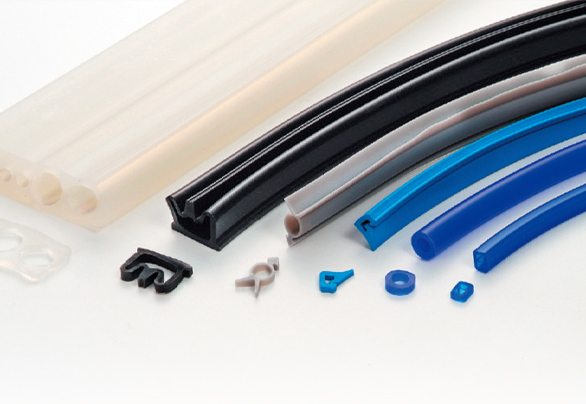
In automotive, electronics, machinery, building doors and windows, medical equipment, and various industrial applications, many rubber components are not standard tubes or flat sheets. Instead, they are designed according to available space, sealing requirements, assembly methods, and environmental resistance, including profile rubber tubes, rubber strips, sealing strips, and custom rubber extruded parts.
Rubber extrusion requires the integration of die design, material formulation, extrusion, and vulcanization conditions to ensure dimensional accuracy and consistent quality. From a practical perspective, this article provides a comprehensive analysis of the custom rubber extrusion process, key cross-section design considerations, comparisons of common rubber materials, and development guidelines to help reduce development risks, shorten prototyping cycles, and improve mass-production yield.
1. What Is Custom Rubber Extrusion? Principles and Suitable Products
1. How Rubber Extrusion Works
Rubber extrusion is a process in which compounded rubber material is fed into an extruder. Through screw conveying, heating, and pressure, the rubber is softened and becomes flowable, then continuously passes through a die with a specific geometric shape to form the required continuous cross-section. After extrusion, the semi-finished product is heated and shaped through a hot-air oven, steam vulcanization (boiler), or other continuous vulcanization system, giving the rubber its final physical elasticity and structural shape.
Analogy: The principle is similar to making noodles——the dough is placed into a machine and extruded through specific openings before being heated and cooked. Rubber extrusion, on the other hand, uses a "continuous vulcanization reaction" to crosslink and shape the strip-shaped rubber material.
Common extrusion structures include solid rubber strips, sponge strips, and co-extruded strips with two hardness levels (solid + sponge).
2. What Products Are Suitable for Extrusion?
Compared with compression (molding) processes, extrusion is particularly suitable for producing long, continuous, hollow, or non-standard geometric products:
- Profile rubber tubes / hollow tubes
- Rubber sealing strips / waterproof and airtight strips
- Rubber sponge strips / two-hardness co-extruded strips
- High-temperature-resistant silicone profile strips
- Automotive door-frame weatherstrips / trunk sealing strips
- Dustproof and vibration-damping strips for industrial equipment
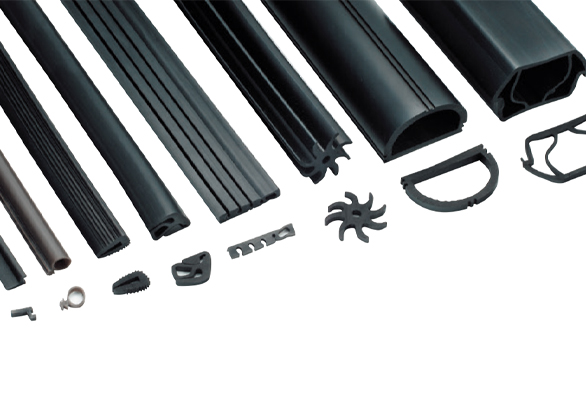
- Rubber strips with various geometric cross-sections (such as U, P, D, T, and E profiles)
"Custom-made" means going beyond standard specifications and completely redesigning dedicated tooling and material formulations according to the customer's engineering drawings, physical samples, installation groove dimensions, estimated compression, hardness, temperature resistance, and chemical resistance.
2. Common Challenges and Solutions in Rubber Extrusion Development
1. Only a Sample Is Available Without Original Engineering Drawings
When repairing parts, developing replacement parts, or refurbishing old machinery, there is often only a section of aged, hardened, or deformed rubber strip available. If a die is directly created by reverse-engineering the sample, the new part may not fit properly or may fail to provide adequate sealing.
- Solution: Measure the actual installation mechanism, groove dimensions, compression direction, and functional requirements. Engineers can then determine the optimal geometric cross-section. During die trials, provide both mating parts for actual assembly testing.
2. Unstable Sealing Performance (Water Leakage, Air Leakage, Difficult Door Closing)
This is commonly caused by improper calculations of cross-section wall thickness, material hardness, and compression ratio. If the design is too thick, assembly resistance becomes excessive (making the door difficult to close); if it is too thin, insufficient compression can result in leakage.
- Solution: Cross-section design should simultaneously evaluate assembly force and compression set. Hollow or sponge structures can be adopted when necessary.
3. Difficult-to-Control Dimensional Tolerances and Deformation
Rubber has elastic memory, resulting in die swell, vulcanization shrinkage, and deformation during cooling after leaving the die. It cannot maintain extremely tight tolerances like machined metal. Cross-sections with significant variations in thickness are also more prone to incomplete filling or eccentricity.
- Solution: Introduce Design for Manufacturability (DFM) evaluation during the initial design stage, and have experienced manufacturers estimate the mold shrinkage compensation.
4. Short Service Life Due to Improper Material Selection
Simply specifying "heat resistance" or "oil resistance" while overlooking actual operating conditions can easily cause the rubber strip to crack, swell, harden, or lose elasticity prematurely.
- Solution: Clearly define the contact media and environment (outdoor UV exposure, fuel resistance, high-temperature steam, etc.) and select materials according to operating conditions.
5. Mold Cost Concerns for Low-Volume, High-Variety Development
During the initial prototyping stage, order quantities are often small, so customers may worry about excessive tooling and modification costs.
- Solution: Reduce initial trial-and-error costs by simplifying the geometric cross-section, conducting trials in stages, or sharing similar dies.
3. Comparison of Common Rubber Extrusion Materials and Applications
Selecting the right rubber compound is the primary condition for ensuring the service life and performance of extruded parts:
| Rubber Material | Main Advantages | Main Limitations | Typical Applications |
|---|---|---|---|
| EPDM (Ethylene Propylene Diene Monomer) | Excellent outdoor weather resistance, ozone resistance, UV resistance, outstanding water resistance, moderate cost | Poor resistance to mineral oils, fuels, and hydrocarbon solvents | Automotive door-frame seals, building door and window weatherstrips, solar module seals, outdoor cabinet waterproof strips |
| NBR (Nitrile Rubber) | Excellent oil resistance (engine oil, lubricating oil, fuel), high wear resistance | Poor weather and ozone resistance; prone to cracking and aging outdoors | Mechanical oil-tank sealing strips, protective pads for hydraulic/pneumatic equipment, industrial oil-resistant rubber strips |
| Silicone | Wide temperature range (-40°C \~ +300°C), non-toxic and odorless, excellent insulation, customizable colors | Lower tear strength, relatively higher cost | Food machinery seals, high-temperature oven strips, medical equipment tubing, electronic waterproof strips |
| CR (Chloroprene Rubber / Neoprene) | Good overall performance, combining basic oil and weather resistance with flame-retardant/self-extinguishing properties | May crystallize and harden at low temperatures; short raw material storage life | Flame-retardant sealing strips for rail vehicles, marine and offshore engineering sealing strips |
| NR (Natural Rubber) | Excellent mechanical elasticity, very high tensile strength, good wear and vibration resistance | Relatively weak oil, ozone, and aging resistance | Highly elastic inflatable rubber strips, heavy-duty vibration and shock-absorbing strips |
4. Five Major Industrial Applications of Profile Rubber Strips
1. Automotive and Transportation
Automotive door weatherstrips, window guide strips, trunk sealing strips, wiring harness waterproof sleeves, and more. Key requirements include weathering resistance, compression resistance, sound insulation and noise reduction, and assembly sealing performance.
2. Industrial Machinery and Equipment Manufacturing
Control cabinets, sheet-metal enclosures, filtration equipment, and areas around pumps. Profile cross-sections can be customized according to sheet-metal grooves to provide dustproof, waterproof, oil-resistant, and vibration-absorbing protection.
3. Electronics, Electrical Equipment, and Communication Cabinets
Outdoor electrical boxes, energy storage cabinets, and 5G communication base stations. Key requirements include IP-rated waterproof and dustproof protection, electrical insulation, and long-term weather resistance.
4. Building Doors, Windows, and Curtain Walls
Aluminum door and window weatherstrips, glass glazing strips, and curtain wall expansion joint seals. EPDM is commonly used to balance smooth installation, long-term elastic sealing, and drainage guidance.
5. Food, Medical, and Laboratory Equipment
Food-grade conveying equipment, oven seals, and medical peripheral tubing. Products may need to comply with certifications such as FDA / USP Class VI, with emphasis on non-toxicity, odorlessness, and high-temperature resistance.
5. Seven Practical Points for Profile Rubber Strip Cross-Section Design
- Maintain uniform and smooth wall thickness: Excessive thickness variation can cause uneven extrusion flow, resulting in cooling distortion and internal stress.
- Avoid sharp corners (increase R angles): Sharp corners can cause stress concentration in the die and tearing during rubber flow. Proper fillets (R angles) can significantly extend die life and improve product flatness.
- Precisely set the compression ratio: For general static sealing, a compression ratio of 15% \~ 35% is recommended (depending on material hardness) to balance sealing performance and assembly feel.
- Confirm the fixing mechanism in advance: This includes groove fitting, adhesive backing (such as 3M double-sided tape), metal skeleton clamping, or bonding to prevent the rubber strip from shifting or coming loose under load.
- Make good use of hollow structures: A hollow tubular cross-section can significantly reduce closing force (door closing force) while providing sufficient elastic contact.
- Use barbs and dual-hardness co-extrusion: For aluminum extrusion grooves, barbs can be designed to prevent pull-out; alternatively, dual-hardness co-extrusion technology can be used (a rigid rubber base for easy insertion and secure positioning, with a sponge/soft rubber top for effective sealing).
- Allow space for die correction: Rubber exhibits die swell and thermal shrinkage characteristics, so fine-tuning allowances for die trials and modifications should be reserved according to the material properties.
6. Five Standard Rubber Extrusion Development Processes
- Step 1: Specification and Requirement Confirmation
Confirm 2D/3D drawings or physical samples, operating environment (temperature/humidity/chemical media), hardness requirements (Shore A), color, cut length, estimated production volume, and secondary processing requirements (adhesive backing, corner joining, punching). - Step 2: Material Recommendation and Cross-Section Evaluation (DFM)
The engineering team evaluates extrusion feasibility and proposes optimization suggestions for cross-sections that are prone to deformation or difficult to form. - Step 3: Die Design and Tooling
The die profile is designed according to the rheological characteristics and shrinkage rate of the rubber compound, followed by precision machining. - Step 4: Prototyping, Assembly, and Functional Testing
Initial extrusion samples are produced, followed by actual assembly testing (closing force, sealing performance, water and air leakage testing) by the customer. - Step 5: Mass Production and Quality Control
Establish batch production inspection standards, including dimensional tolerances, hardness, tensile strength, and batch-to-batch consistency.
7. How to Reduce the Failure Rate of Custom Extrusion Development?
- Provide complete mating parts: In addition to rubber strip drawings, always provide the corresponding installation groove dimensions or mating part samples.
- Confirm the environment before selecting rubber materials: Avoid selecting materials based solely on price. Outdoor applications require UV-resistant grades, while applications involving oils or grease require oil-resistant rubber.
- Emphasize actual assembly verification: Sample approval should not be based solely on dimensional measurements. Actual installation should be performed for compression and airtight/watertight testing.
- Understand rubber tolerance limits: Elastomers cannot achieve the same precision tolerances as metal. During the initial design stage, refer to the ISO 3302-1 extrusion tolerance standard.
- Conduct phased small-batch trial production: Before mass production, verify assembly stability through small-batch production to reduce the risk of major die modifications.
8. How to Choose a Professional Rubber Extrusion Manufacturer?
An excellent rubber extrusion manufacturing partner should have the following core capabilities:
- DFM cross-section review and optimization capabilities (identify potential issues before tooling)
- Familiarity with various synthetic rubbers and formulation development
- Extensive practical experience with profile tubes, dual-hardness co-extrusion, and sponge extrusion
- Ability to provide secondary processing (precision cutting, corner welding, adhesive backing, punching)
- Rigorous die trial validation and dimensional tolerance control capabilities
Evaluation Principle: When selecting a supplier, do not focus only on tooling and unit price. Repeated die modifications, poor assembly, and customer complaint costs caused by inadequate initial design are often far greater than the initial price difference.
9. Conclusion: Quality Profile Rubber Strips Start with Requirements and Cross-Section Design
Custom rubber extrusion is a professional technology that combines material science, die mechanics, and manufacturing processes. The key to the success of profile rubber strips lies in their ability to maintain stable sealing and assembly performance over the long term under demanding environmental conditions.
At the early stage of project development, it is recommended to prepare drawings/samples, operating environment conditions, and installation requirements, and work with a professional rubber extrusion team to evaluate cross-section feasibility. This enables the development of high-quality custom sealing products in the shortest time and at the lowest cost.
Need Custom Rubber Extrusion or Profile Sealing Strip Design Advice?
Feel free to provide your 2D/3D drawings or sample assemblies. Our professional engineering team can evaluate the material, tooling feasibility, and optimal mass-production solution for you!